Awareness

 by Sara Wagner, CFDM Faculty

If we confess our sins, he is faithful and just and will forgive us our sins and purify us from all unrighteousness. 1 John 1:9

I was asked if I could write a blog about awareness. It is rather humorous because I tend to be a fairly oblivious person most of the time as my spouse will attest. But tonight, there was awareness. Not the felt presence of God, but a real and growing awareness of His promise of purification to meet my growing awareness of how much I need that purification. I had a deepening of the understanding that to be the Beloved is to become aware and attuned to the promises of God… to realize they are not merely words on a page but cool, living water to a dry and thirsty soul. To be the Beloved is to be caught up in the promise… to be held by it and nurtured in it… allowed to soak in it… enabled to let it penetrate to a deeper place within. Becoming aware within one’s self of the promise, from my experience, takes time. I have noted that when I do seem to receive that deeper message… that deeper awareness of the message and what it promises, I look back and see that the message has been sent on many occasions, I just hadn’t been aware of it. I have also noticed that there tends to be a genuine physical sensation within me once I do become aware. Perhaps it is like a pregnant woman who suddenly starts to notice that the movement inside of her of the unborn baby (quickening) really is something moving in her that is other than herself. She didn’t “cause” it, it happened of its own accord. So it seems to be is the movement of the Spirit. I can not cause it, nor can I, in and of myself, become aware of it without the grace of God providing both the movement and the awareness of the movement of His Spirit.

2015-08-01 09.39.59

(c) Mona Chicks 2015

It has been a rather hard season for me with lots of confusion and dryness and some very deep darkness. Tonight, however, God gave me the gift of this passage. He illuminated the phrase “… and purify us from ALL unrighteousness”. This promise seemed to first wash over me and then sink into the crevices of my soul…. Purify me from ALL unrighteousness?….. ALL unrighteousness!! This promise became alive within me…. ALL unrighteousness. This truth seemed to ebb and flow within me. It brought calm and hope…. ALL unrighteousness. How Blessed! I hope this blog will give you hope if you are also in a dry, dusty or dark season. Even if the promises of God seem far away right now, don’t lose hope…. all of a sudden a promise will sneak up on you and catch you by surprise like a rogue wave… for those promises are real and they are meant for you, the Beloved.

Falling

by Rev. Terry Tripp, Spiritual Direction Program Director

The summer heat has abated and the signs of Fall are coming in. It was an unprecedented summer. I wonder what this new season of change wfall colorsill be that is upon us. Each new season pretends a promise of movement in weather, in scenery, in rhythms, in hoped for change or in kept relationships. Yet, what God always promises in change is His faithfulness. But I have come to wonder about His faithfulness. Faithfulness to what?


More than anything it is a faithfulness to love. A love that we cannot make in our image. Only in the image of Christ are we introduced to true love. A love that bears pain, and therefore, a love that allows emptiness as a prerequisite to fullness. The Gospel of Matthew puts it this way;

That is why I am telling you not to worry about your life and what you are to eat, nor about your body and what you are to wear. Surely life is more than food, and the body more than clothing! Look at the birds in the sky. They do not sow or reap or gather into barns; yet your heavenly Father feeds them. Are you not worth much more than they are?  Mt. 6:25-26

To receive God’s gift of love we need to make room for it. To not fill ourselves with empty cravings, but long for/desire God and trust that He will give us what we need when we need it.

In falling we can be caught; in being empty we can be filled. It is a vulnerable way of living. It is a faith-filled way of living. It is about letting go in order to find oneself being led, whether you know anything of it or not (as Thomas Merton contended). We at CFDM invite you again to a renewed desire for God’s way, God’s fulfillment, God’s ever present self-communicating intimacy. Know that you are loved beyond all that you can imagine and held when all seems to have fallen away.

Macrina Wiederfehr in her book, “Seasons of Your Heart” writes beautifully this act of surrender, of vulnerability, of welcoming a new season. Her poem: “The Sacrament of Letting Go”

Slowly
she celebrated the sacrament of letting go.
First she surrendered her green,
then the orange, yellow, and red
finally she let go of her brown.
Shedding her last leaf
she stood empty and silent, stripped bare.
Leaning against the winter sky
she began her vigil of trust.

And Jesus said:
Why do you worry about clothes? Remember the flowers growing in the fields; they do not fret about what to wear; yet I assure you not even Solomon in all his royal robes was dressed like one of these.

Shedding her last leaf
she watched its journey to the ground.
She stood in silence
wearing the color of emptiness,
her branches wondering;
How do you give shade with so much gone?

And Jesus said:
Do not be troubled or needlessly concerned.

And then,
the sacrament of waiting began.
The sunrise and the sunset watched with
tenderness.
Clothing her with silhouettes
they kept her hope alive.

They helped her understand that
her vulnerability,
her dependence and need,
her emptiness,
her readiness to receive,
were giving her a new kind of beauty.
Every morning and every evening they stood
in silence
and celebrated together
the sacrament of waiting.

And Jesus said:
Now if that is how God cares for the wild flowers in the fields which are here today and gone tomorrow, will He not all the more care for you…?

Unlikely Places of Grace

by David Hicks, Spiritual Formation Faculty

“Tremble, O earth, at the PRESENCE of the Lord,
at the PRESENCE of the God of Jacob,
who turned the rock into a pool,
the hard rock into springs of water.”
Psalm 114:7-8

2014-07-08 15.54.20

God often does the unexpected not only because He can (that goes without saying) but also because it usually throws us off just enough to where we actually notice He is doing something. I’m convinced that He uses the common and the likely but these are also the very places where we often miss seeing the moving of His grace. It is precisely because they are likely that we sometimes see grace as common, natural, coincidental, rather than a divine break-in from a Heavenly Intruder. To shake us out of our blind indifference sometimes God comes in unlikely places of grace.

Psalm 114 refers back to the Exodus 17 story of Moses striking the rock at Horeb which then produces water to satisfy the thirst of the Israelites. This ‘striking incident’ was preceded by the Israelites complaining to Moses about their condition and wondering if God was really with them or not. God meets their need, but in an unlikely way. The most likely solution to the Israelites problem (thirst) would have been for God to lead them to a river or stream or spring where they could drink. Those would be likely places, normal places, to get water. But God chooses an unlikely place, perhaps the most unlikely place of all, to satisfy their thirst – a rock. A rock is not something that I would have thought of. Of all the places I can think of to satisfy thirst I would have never come up with a rock. Rocks are, to say the least, unlikely places to find water.

Put this in a long list of Biblical examples of God’s grace coming from unlikely places: an ark is built far from the nearest body of water; a donkey speaks a word from God; a teenage boy kills a giant and then rules a nation; a man of God is told to marry a prostitute as a living example of God’s love; a fish becomes the vehicle to deliver a prophet; water gets turned into wine; a boy’s lunch feeds 5,000; and the most unlikely place of all for God’s grace to be found is when the finality of a cross and a tomb become the birthplace of eternal life.

Though not nearly on as grand a scale as these I can come up with my own list of unlikely places of grace. Just like the Israelites thirst, I too at times have felt a desperate need. And just like the Israelites complaint, I have sometimes said (or at least thought), “God, are you with me or not?” I have looked for answers and solutions to my deep needs in all of the most likely places. But more times than not it has been in unlikely places where God has met these needs.  In fact sometimes these unlikely places have at first appeared as hard, immovable obstacles (like rocks). I perceive them as things that are actually standing in the way of what I most need, or at least think I need. There are all kinds of apparent obstacles in our lives that God may want to turn into an unlikely spring of grace to refresh us and to bless those around us.

How does this all happen? Psalm 114 above gives us the answer twice. The “Presence” of the Lord. I capitalize the word Presence because here it almost sounds like person’s name. “Presence” is a person. God’s presence transforms the unlikely broken, hard places of our lives into springs of grace and mercy. And this really is what our heart most thirsts for: the Presence of God, filling the most unlikely places with His grace.

Transition

by Gwen Shipley, CFDM Faculty

I’m no John Lennon but imagine with me a world free from the dehumanizing notion that one’s value depends on one’s productivity. (And you may indeed be saying that I’m a dreamer…!)

It is difficult to discern whether this over achieving ethic is…
a) embedded in the adamic DNA
b) the result of cultural conditioning or
c) a pathological coping mechanism survivable only by the fittest.
Perhaps by the 21st century A.D. we might be expected to know better.

2015-06-30 00.02.32

Whatever the source, and admittedly a challenge of degrees, it seems nearly everyone is touched by the toxic contaminant of proving our worth by doing. Given the message of the Gospel, grace through faith, it is reasonable to assume that the point of reference would be different among those identifying as Christian. But, alas! As with the divorce rate among the self-proclaimed faithful, so it is with the sacred romance of The Beloved gone awry.

Therefore it is with good reason that CFDM’s Formation 1 begins by establishing that we are The Beloved of God. Period. That before we do a blessed thing, God is at work willing and doing of God’s good pleasure—which is all love—before we utter so much as a feeble squeak or flex a wimpy bicep.

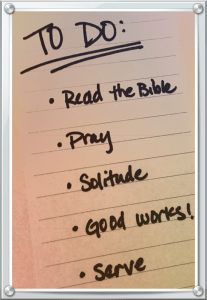
“Come to me,” Jesus said, “you who are weary and heavy-laden; I will give you rest. (Matt. 11:28) For some this is a first encounter with freedom. For many others it becomes little more than a repurposed to-do list. Instead of learning the unforced rhythms of grace, we begin to assume undue responsibility for our own righteousness. In that case, it can be disorienting to wake to the realization that consent is what God asks us to bring; that the heavy lifting is initiated and performed by the Spirit. In Christian formation we are challenged to take seriously this theological butterfly effect, a shift which has major implications for our relationships with God, ourselves and others. Seeing the futility of well-intentioned self-effort can produce disillusionment, disappointment, confusion, anger—especially if we’ve been at it for some time. It is a painful transition, but one that takes us deeper if we will allow it.

For me, one such season of transition included releasing a specific and valued identity. I was stripped of the ability to contribute to the household income, and routinely isolated from friends, family and fun. For someone whose core identity is wrapped in a package of doing, this was death-dealing before it was life-giving. The things I reached for to prove my worth were removed in order for me to see myself valued with or without them, a process that continues. Thomas Keating calls these “over-identifications” and “emotional programs for happiness.” You may have found yourself on a similar path.

In fact, what is being birthed in such times is the freedom to be known and loved as the person one truly is, not as one believes they should be or could be, or is even in the habit of being. It is rather entrance into “a new world that is manifested in daily life, not only by greater peace, calm, and sometimes, greater joy, but also by a greater concern for others in practical ways.” (1)

If you find yourself in a time where access to familiar possibilities is suspended, you might ask things like, “Am I in transition? What is being birthed? Can I let myself simply be, and be loved by God in this time? How might you be deepening my experience of you, God? What would you like me to see, how else would you like me to know you?” Keep this in mind: Any labor and delivery nurse—my daughter is one—knows well the intense period between the early and later stages of giving birth termed transition. Support is vital as all attention and energy turns inward in preparation for the final moments that produce the long-awaited, messy promise. It is a delicate, dangerous passage and no new life emerges without it.

“In a dark time, the eye begins to see.” Theodore Roethke

1. Keating, Thomas, Manifesting God. (New York, NY: Lantern Books, 2005) p.96

Compassion

By Shelly Morse, CFDM Alum and Board Member

Be Compassionate just as your Father is compassionate. Luke 6:36

(c) Mona Chicks

(c) Mona Chicks

The life of the beloved is one of compassion. There is so much grief, poverty, and loss in this life, but we can offer another the great gift of not having to walk alone in their need. That is the gift of compassion. We have been well equipped for this because we have been loved well by God.

Compassion takes on many different forms, but caring seems to me to be one of the most basic human responses to a God that loves me, and for another made in that same God’s image. I care when I am present to the one who suffers, and when I stay present, even though I cannot change their circumstances. Often we are not able to fix the problem for another but we are always able to care.

I have found great joy in walking alongside those in need. It is true that I have received more than I have given. I am deeply grateful that God has designed this life in such a way that I get the opportunity to be Christ’s ambassador on this earth. Deep joy is the secret gift of compassion! It’s no wonder that God calls us to love our neighbor.

Caring is born out of relationship. The core meaning of care is to “be with” a person who is suffering or needy. To care means therefore to hear another’s cry. Who do you hear crying? Is there someone God has put near you that needs your presence in their painful circumstance? I challenge you to connect with another’s need and care.

How do you and I live what God asks in passages such as Micah 6:8? “He has shown you, O mortal, what is good. And what does the LORD require of you? To act justly and love mercy and to walk humbly with your God.” How do we live a merciful, just and humble life towards the powerless and broken? I believe God has made it possible through his great love for us. Because we have been loved well and because He is such a deep well for us to draw from, we can be present with, listen to, and embrace another in their need.

Caring is all about being present to one who is powerless, accepting that we may not be able to take their pain away, but we can surely be willing to share it.

On the Journey

by Rev. Mona Chicks, CFDM alum and Board Member
(c) Mona Chicks all rights reserved.

(c) Mona Chicks all rights reserved.

During Lent, I found myself unintentionally meditating on the post-resurrection appearances of Jesus. One in particular was rehearsed in a few contexts and situations, and led me to wonder what God was trying to tell me. I finally clued in that maybe I should intentionally meditate on this story. It was the story of the road to Emmaus, from Luke 24.13ff.

I can identify with Cleopas, one of the disciples on the road to Emmaus who journeyed with a stranger, only to find it was the risen Jesus. Cleopas is one of the first evangelists, though he didn’t yet know the end of the story. He walked and talked with this stranger, telling him all that had happened to Jesus. He spoke of his hopes and dreams about this man he had followed, dreams that had been dashed when the hope for insurrection turned to non-violent arrest, trial, and execution. He spoke of bewilderment, when the body of this man was missing from the tomb. He listened, as the stranger explained it all to him. But he did not yet know. He did not yet recognize the risen Jesus.

You would expect that Cleopas and the other disciple would recognize Jesus as soon as he began teaching. They had heard him teach frequently. But they didn’t. You would think that, having spent three years or so with this man, they would recognize his face, his form, his mannerisms. But they didn’t.

They didn’t recognize him until they ate with him. Perhaps they needed the journey to prepare them for the shock of seeing him resurrected. Maybe Jesus waited to reveal himself until they had shown hospitality and friendship to the stranger. How like Jesus to reveal himself in an unconventional, unexpected way. He’s spent his ministry doing the unexpected.

But it makes me wonder, in what ways am I missing what Jesus is doing because I’m looking for something else? How could I be losing out on a walk with my Savior, because it isn’t what I expected? As I spend time with Him each day, I ask for my eyes to be opened, so I can see Jesus as he is revealing himself in everything I experience that day. The disciples’ “hearts burned within them,” and that gives me hope for myself, that as I pay attention to the people and circumstances around me, I will come to recognize Jesus, even in unexpected places.

Amen, may it be so.

Shapes of Fear

by Margie Van Duzer, CFDM Faculty

During the first week of Lent, I had the opportunity to visit the Museum of American Art in Washington, DC. Now, I am absolutely no art expert. I never took an art class or art history class in high school or college. The embarrassment and shame experienced through my elementary school art projects lingers to this day. However, as somebody who believes God can speak through this creative medium, I consciously prayed as I went from painting to painting; I asked to have the eyes to see what God wanted me to see. I was drawn in by a dark and moody painting of four robed bodies. Although the robes covered their heads, one of them was facing directly towards me while I looked at the painting. Well, not exactly facing me because this shape had no face. Just darkness where a face should have been. The other three were turned to the side, so they were completely covered in robes. All four of them were wearing easily visible shoes-shoes for running away. The painting was called “Shapes of Fear”. I found myself identifying with these shapes. When I am in a state of fear or anxiety, it is as if I am faceless. I lose sight of the reality that I am God’s beloved daughter, loved in all of who I am, a person created, named, known and redeemed by Christ. Instead, I feel like a faceless, nameless non-entity, where my only distinguishing feature is my overwhelming inclination to flee.

Shapes of Fear 1930-1932 Maynard Dixon Born: Fresno, California 1875 Died: Tucson, Arizona 1946 oil on canvas 40 x 50 1/8 in. (101.5 x 127.3 cm.) Smithsonian American Art Museum Bequest of Henry Ward Ranger through the National Academy of Design 1956.10.1 Smithsonian American Art Museum 2nd Floor, North Wing. Used with permission.

How dark and lifeless these shapes looked, so far removed from God’s intent for us as God’s beloved. And yet, how often I live in that place of faceless fear, not, as Henri Nouwen would say, claiming my belovedness.

This Lent, with this picture still looming large in my mental background, I have decided to make it a spiritual discipline to consciously choose “belovedness” whenever the feelings of fear arise. And they do arise. Surprisingly, I have found that the memory of these four robed shapes somehow make it easier to name the fear when it comes and claim my rightful identity. Instead of making a move to flee, I am able to stop and turn towards the God who intimately knows all and lovingly is with me still.

What’s in a Name? An Ash Wednesday Meditation

by Rev. Terry Tripp, Co-Director CFDM

What’s in a Name?

220px-Hello_my_name_is_sticker

In 1991 the best movie of the year was “Dances with Wolves”. You may remember this heroic film about a civil war hero who travels West to join a far out post in the Western Territory of the US. His loneliness creeps up on him over time and in a desperate attempt to make a connection with another living being, he tries to befriend the wild wolves in the area. This is when the nearest Native American Tribe first observes the soldier’s personality and quality that eventually draws both parties together in a life long commitment to one another. The soldier is there after named “Dances with Wolves”. In the Native American tradition, a name signifies a person’s personality, purpose, quality of character, or station in life. The name may be given early or later in life, perhaps changed over time to signify new tasks, or accomplishments. Do you remember looking up the meaning of names you picked out as possibilities for your expectant child? Did the meaning matter or were you satisfied with the sound of the chosen name? Do you know what your name means?

In the book of Isaiah, the prophet uses rich language to describe God and finds words that name God for his nature, character, acts of salvation and creation, and for his ultimate purpose for you and I. In a familiar text out of chapter 9, we read these names for God the Savior, the Messiah, the coming one: Wonderful Counselor, Mighty God, Everlasting Father, Prince of Peace. And then in chapter 40, Isaiah again uses rich language to describe a victorious Savior: the glory of the Lord revealed, his breath is upon the people, the Lord God comes with might, his arm rules for him, his reward is with him, he is a shepherd. Now in contrast, Isaiah 53 gives us names for our Lord Jesus that are less than majestic: a root out of dry ground, no form or majesty to look at, undesirable, despised and rejected, a man of suffering and acquainted with weakness, one from whom others hide their faces, held of no account, one who carries our diseases, stricken, struck down by God and afflicted, wounded for our sins, his bruises heal us, carrier of our sins. Are you attracted to this Lord or are you confused, or are you repelled?

It seems that God is always doing more than what seems to be happening at first glance. God loves to use the unexpected, to reverse our incomplete understanding of his mystery. God brings together in the story of Jesus, complete opposites. In fact, God seems to delight in using the opposite character quality of what might be expected in order to achieve the Lord’s purposes.

I experienced as a Pastor, in tangible ways, that God can bring wholeness and perspective through what would to the observer be unimaginable. One such relationship was companioning a young couple in their grief over the loss of their baby girl, just 19 weeks gestation. The mom was diagnosed with 3rd stage melanoma. At the same time it was  discovered that their long awaited baby girl had a congenital defect that put her survival post birth in question. Either the cancer or disease was going to snuff the life from their dreams for this long awaited child. This tender mother and father prepared to give birth to their daughter prematurely – and then held her in their hand until life seeped away – she was named Hope. Hope, their daughter, was going to be for them the hope from God that life will come from death.

As the names that Isaiah gives to our Lord centuries before his birth, capture God’s story of finding freedom in pain, at the same time that glory depicts sacrifice; the names that we live into can describe how loss can bring healing, absence can discover fullness. God’s story is reflected in our story every time we choose faith, hope and love, no matter what our circumstances are.

Lent is a time to reflect on how we are in the process of being healed from the inside out – being re-named for God’s purposes. In naming our fears, pain, rejections, hatred, betrayals, guilt, need for control, losses, … we have an opportunity to experience how the God who became all those things for us can change our name. We can discover anew who God is for us and who we are for God.

What’s in a name? Some might say everything, especially after reading the book of Isaiah. However you understand how to be in relationship with God, there is waiting a name that God gives you that describes who you are to Him right now – and, a name that you call God in this season of your life that describes how He is for you. Listen for those names; yours from God, and God’s from you. You might begin your prayer with questions: how do I experience God right now in my life? What in my life circumstances tells me that I need God and God desires me? And finally, if Lent is a time that we experience our mortality and therefore our great need for a Savior; what do I need to name in me that gets in the way of experiencing new life on Easter morning?

Being the Beloved

by Boni Piper


Dear Beloved,

This blog is called, “Being the Beloved” because that is who we are, even though we so seldom live in that place. It’s hard to reconcile the “dirty rotten sinner”(as a friend of mine calls herself) with “the Beloved.” Yet isn’t that the very thing Jesus turned on it’s head? His death and resurrection let the sinner become the Beloved. These two themes are constant in scripture and the church. I learned about the “dirty rotten sinner” way before I learned about being the Beloved. Sinner is the obvious one. I see my sin. I do the things I don’t want to do. I turn from God more than I like to admit. And in that very place of sinning, God’s Spirit touched me and redeemed me and gave me a new name…Beloved.

I think it pains God when I forget that and when I choose to live in the “sinner” lie rather than the beloved truth. Where I make my home changes everything. It is my identity, the spirit that comes from me, the way I treat others and myself, and defines who God is to me and who I am to God. That God the Father sees me through the eyes of Jesus and what he has done demands that I see myself as his Beloved. The love child. The one he loves to spend time with. The one he woos and calls and equips. Shame has no place in the life of the Beloved for God looks upon her/him with love, and smiles!

Being the Beloved means believing in what God has done and said about you. How much of believing you are the Beloved forms your identity? How does claiming the name Beloved help you identify with your true self? What would be different in your life, if being the Beloved was something you believed with all your heart?

That’s what this blog is about. We want to encourage each other in this God given identity of being the Beloved. Knowing that makes us different, but different how? We want to be more about being than doing, but we don’t want to “be” just anything. We want to act, feel and demonstrate that our being defines us, and that being is, the Beloved. It should mean everything to us. It should form our identity, decisions and actions.

It is our hope that this blog would help you in forming your identity, in your discernment and in your actions. Please feel free to dialogue so we can join our wisdom together on this crucial part of being Christian.